26 November 2011

Longer Term View : Ichimoku Dependent!

Some time ago, I posted a weekly chart, requesting all my readers to exit out of equities because something happened in the charts which was signalling the end of bull market which started from October 2008. Which meant all rallies should be now sold into. That happened in January of this year, when Nifty after making its first lower high, formed a bearish engulfing candlestick pattern. Subsequently Nifty gave a sell signal on the Ichimoku Cloud as well. Since then Nifty has made a series of lower highs and lower lows.


This week it has broken the 200 week moving average, another confirmatory signal, which the long term players should beware of. Investing now, and giving valuation as a reason, would be foolhardy. The above chart shows how Nifty took some support at the 200 week moving average, and also gave a buy signal in October but the rally soon fizzled out and since it broke the 4700 support, another round of heavy selling could be expected even if there is some relief rally.

I wanted to point out, in this post the beauty of Ichimoku cloud which did not give any sort of buy signal, even though there were strong rallies from February to April and then in October. Ichimoku still believes that the trend is down and because its below the cloud expecting any kind of immediate support would be stupid.

I would like to point out that the monthly charts shows 4000 as support area.


Technically from an investing point of view, I will until there is a higher low formed on the charts and Ichimoku buy signal.

Could Not Resist Re-Posting It !


Happy Thanksgiving — the Dow could be going to 4,000


I hate to be the turkey of the day/month/year, but we are in a bear market. The only question is how low will this turkey go?
I am a chartist. I deal in chart patterns. I deal in possibilities, not probabilities and certainly not in certainties. I can only state what a chart is telling me by its geometric construction — and geometric patterns, even when clearly identified, are subject to failure.
Nevertheless, I am obligated to call a chart for what it is. Part of chart analysis is determining the price targets implied in a certain chart patterns. I get loads of criticism on this one. Whenever I state an implied objective of a pattern I hear the same whine:
“But, but, but,but, Brandt, you say in your book that charts are a trading tool and not to be used for price forecasting. Yet, Brandt, you make price forecasts. You are confusing me. You say charts should not be used for making price forecasts, but that is exactly what you are doing.”
If you are in this camp, I have one thing to say to you –  get over it, learn to live with it.
Charts are NOT for price forecasting. But a chart pattern carries an implied price move. I recognize that any given chart pattern has a significant chance of failure. But until a pattern fails or is not modified by a contrary pattern, then price targets are a good guideline.
When prices act contrary to the implications of a chart, then I run for the hills. But until then, I retain strong opinions (weakly held). If you can’t understand this nuance, that is your problem, not mine.
OK, all this was a build up to your Thanksgiving gift — a price forecast in the DJIA. Please step back and take a 30,000 foot view with me.
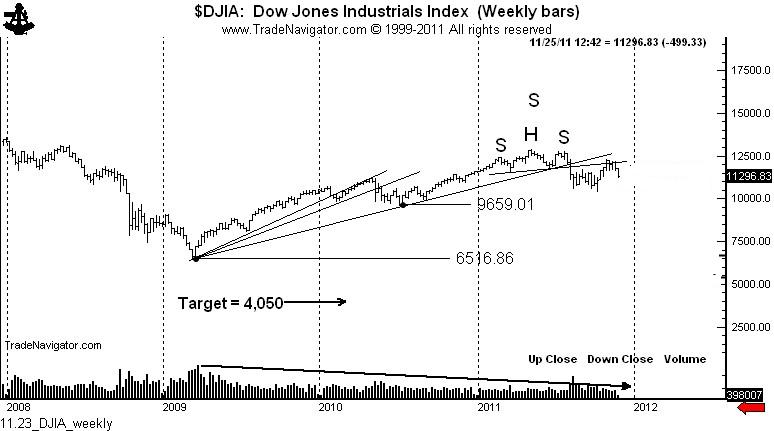
The rally from the March 2009 low was on decreasing volume. Rallies that do not draw in the public are very suspect, and prove more often than not to be corrective rallies. In this case, the correction is of the 2008 to 2009 price decline. That’s right, the volume profile of the this 32-month rally is much more typical of a bear market rally than of a genuine bull trend.
The founders of classical charting  (Schabacker, Edwards, Magee) identified something called a 3-fan principle. The 3-fan principle specifies that a corrective rally may be defined by trendlines with decreasing angles of attack. The concept also specifies that the violation of the third fan line establishes the top  of the corrective rally — and that the subsequent decline will retrace the entire distance of the corrective rally.
Now, you may want to give me with all the reasons why a return to the 2009 low is not possible. That’s fine — but, keep it to yourself. I will change my mind when price makes me change my mind, not one moment before.
The fact that the daily and weekly charts completed a H&S top simultaneously with the violation of the third fan line is a confirmation that the May and July highs will not be breached. Another classical charting principle is that H&S tops and bottoms (when they meet all of the criteria for the pattern, which this H&S top did do) represent a major turning point in a trend.
Next, let’s move from a 30,000-foot view to a perspective from the space station. Should the implications of the 3-fan principle be realized, something very, very, very (do I need to repeat the word “very” again?) significant would become apparent to a chartist.
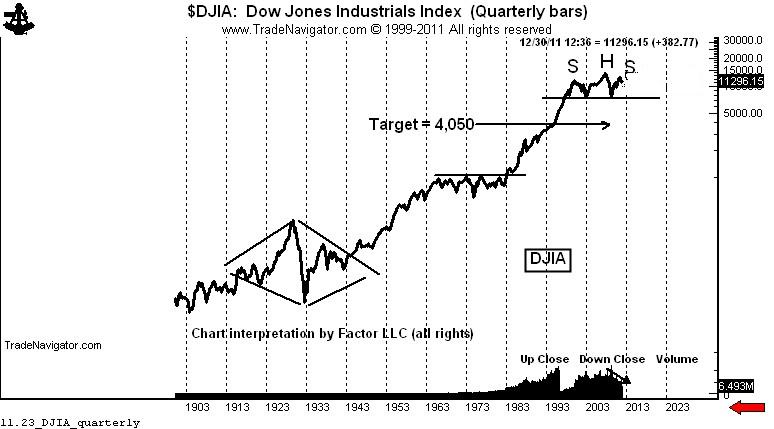
A move back to the 2009 low on the quarterly semi-log chart sets up the possibility (not probability, not certainty) of a 13-year H&S top whereby the entire advance from the March 2009 low is nothing more than the right shoulder of this massive configuration.
Should the market decline toward the 2009 low, then the massive H&S top on the quarterly chart becomes a real (but wild) possibility. The rules of classical charting specify that a decisive completion of a H&S top should lead to a decline equal to the height of the H&S.
On an arithmetic basis, the target in the Dow would become lower than 1,000. On the semi-long chart the target would be around 4,000. So I will use the higher target.
Do I really think the DJIA will decline to 4,000? I have no idea. But I do know this — that if it does it will be one wild (and hopefully profitable) ride.

19 November 2011

Nifty : Channeling Challenge

Last week's market action has caught the bulls off guard. After the October rally November was expected to be a follow through month or at the most a consolidation period. Well, taking market lightly never works!


Above is the weekly chart, the crack below 20 week moving average, shows that the bullish momentum is long gone and its time to beware of the bears. The other important observation is Nifty's inability to even challenge the upper trend line. This shows that Nifty was weak in its up move and the down move would be harsher!

Obviously all hopes are now on 4700 providing the support. I have generally seen, when some kind of level is over watched the market tends to ignore it and catch most people on wrong foot. So we can expect no support there (bulls would be crushed) or Nifty not at all reaching there (bears would be fooled). I believe the former to be more likely. The ultimate trick the market can play would be to fool both bulls and bears, which would be crashing below 4700 stop out all bulls and suck the bears in and then rally furiously much higher! This would be the toughest scenario to work on and "the vigilant" would be rewarded.

Another point I would like to make is about volumes. I know that the F&O volumes have been quite high, but the cash market volume is certainly pathetic. You can see how whole of 2011 have been on quite low volumes. Traditional technical knowledge suggest that a sell off on low volumes is a sign of correction in a predominant uptrend. But there is another aspect of it, low volumes can also be a reason for concern. Low volumes means there are less sellers with conviction, but it also means there are less buyers with conviction. So the correction with lower volumes cannot be taken for granted to be a dip to buy in.

I will be surprised if 4700 provides a great deal of support in coming weeks. The lower trend line is one to be watched and in case it breaks, well, welcome to the panic street!

Six Keys to Being Excellent at Anything


Six Keys to Being Excellent at Anything

I've been playing tennis for nearly five decades. I love the game and I hit the ball well, but I'm far from the player I wish I were.
I've been thinking about this a lot the past couple of weeks, because I've taken the opportunity, for the first time in many years, to play tennis nearly every day. My game has gotten progressively stronger. I've had a number of rapturous moments during which I've played like the player I long to be.
And almost certainly could be, even though I'm 58 years old. Until recently, I never believed that was possible. For most of my adult life, I've accepted the incredibly durable myth that some people are born with special talents and gifts, and that the potential to truly excel in any given pursuit is largely determined by our genetic inheritance.
During the past year, I've read no fewer than five books — and a raft of scientific research — which powerfully challenge that assumption (see below for a list). I've also written one, The Way We're Working Isn't Working, which lays out a guide, grounded in the science of high performance, to systematically building your capacity physically, emotionally, mentally, and spiritually.
We've found, in our work with executives at dozens of organizations, that it's possible to build any given skill or capacity in the same systematic way we do a muscle: push past your comfort zone, and then rest. Aristotle Will Durant*, commenting on Aristotle, pointed out that the philosopher had it exactly right 2000 years ago: "We are what we repeatedly do." By relying on highly specific practices, we've seen our clients dramatically improve skills ranging from empathy, to focus, to creativity, to summoning positive emotions, to deeply relaxing.
Like everyone who studies performance, I'm indebted to the extraordinary Anders Ericsson, arguably the world's leading researcher into high performance. For more than two decades, Ericsson has been making the case that it's not inherited talent which determines how good we become at something, but rather how hard we're willing to work — something he calls "deliberate practice." Numerous researchers now agree that 10,000 hours of such practice is the minimum necessary to achieve expertise in any complex domain.
That notion is wonderfully empowering. It suggests we have remarkable capacity to influence our own outcomes. But that's also daunting. One of Ericsson's central findings is that practice is not only the most important ingredient in achieving excellence, but also the most difficult and the least intrinsically enjoyable.
If you want to be really good at something, it's going to involve relentlessly pushing past your comfort zone, as well as frustration, struggle, setbacks and failures. That's true as long as you want to continue to improve, or even maintain a high level of excellence. The reward is that being really good at something you've earned through your own hard work can be immensely satisfying.
Here, then, are the six keys to achieving excellence we've found are most effective for our clients:
  1. Pursue what you love. Passion is an incredible motivator. It fuels focus, resilience, and perseverance.
  2. Do the hardest work first. We all move instinctively toward pleasure and away from pain. Most great performers, Ericsson and others have found, delay gratification and take on the difficult work of practice in the mornings, before they do anything else. That's when most of us have the most energy and the fewest distractions.
  3. Practice intensely, without interruption for short periods of no longer than 90 minutes and then take a break. Ninety minutes appears to be the maximum amount of time that we can bring the highest level of focus to any given activity. The evidence is equally strong that great performers practice no more than 4 ½ hours a day.
  4. Seek expert feedback, in intermittent doses. The simpler and more precise the feedback, the more equipped you are to make adjustments. Too much feedback, too continuously can create cognitive overload, increase anxiety, and interfere with learning.
  5. Take regular renewal breaks. Relaxing after intense effort not only provides an opportunity to rejuvenate, but also to metabolize and embed learning. It's also during rest that the right hemisphere becomes more dominant, which can lead to creative breakthroughs.
  6. Ritualize practice. Will and discipline are wildly overrated. As the researcher Roy Baumeisterhas found, none of us have very much of it. The best way to insure you'll take on difficult tasks is to build rituals — specific, inviolable times at which you do them, so that over time you do them without having to squander energy thinking about them.

I have practiced tennis deliberately over the years, but never for the several hours a day required to achieve a truly high level of excellence. What's changed is that I don't berate myself any longer for falling short. I know exactly what it would take to get to that level.
I've got too many other higher priorities to give tennis that attention right now. But I find it incredibly exciting to know that I'm still capable of getting far better at tennis — or at anything else — and so are you.

Here are the recent books on this subject:

* Thanks to commenter Rick Thomas for pointing out the misattribution.

Tony Schwartz is president and CEO of The Energy Project. He is the author of the June, 2010 HBR article, "The Productivity Paradox: How Sony Pictures Gets More Out of People by Demanding Less," and coauthor, with Catherine McCarthy, of the 2007 HBR article, "Manage Your Energy, Not Your Time." Tony is also the author of the new book "The Way We're Working Isn't Working: The Four Forgotten Needs that Energize Great Performance" (Free Press, 2010).